Architecture
High-level design and internal structure of calvigil.
Table of contents
System Overview
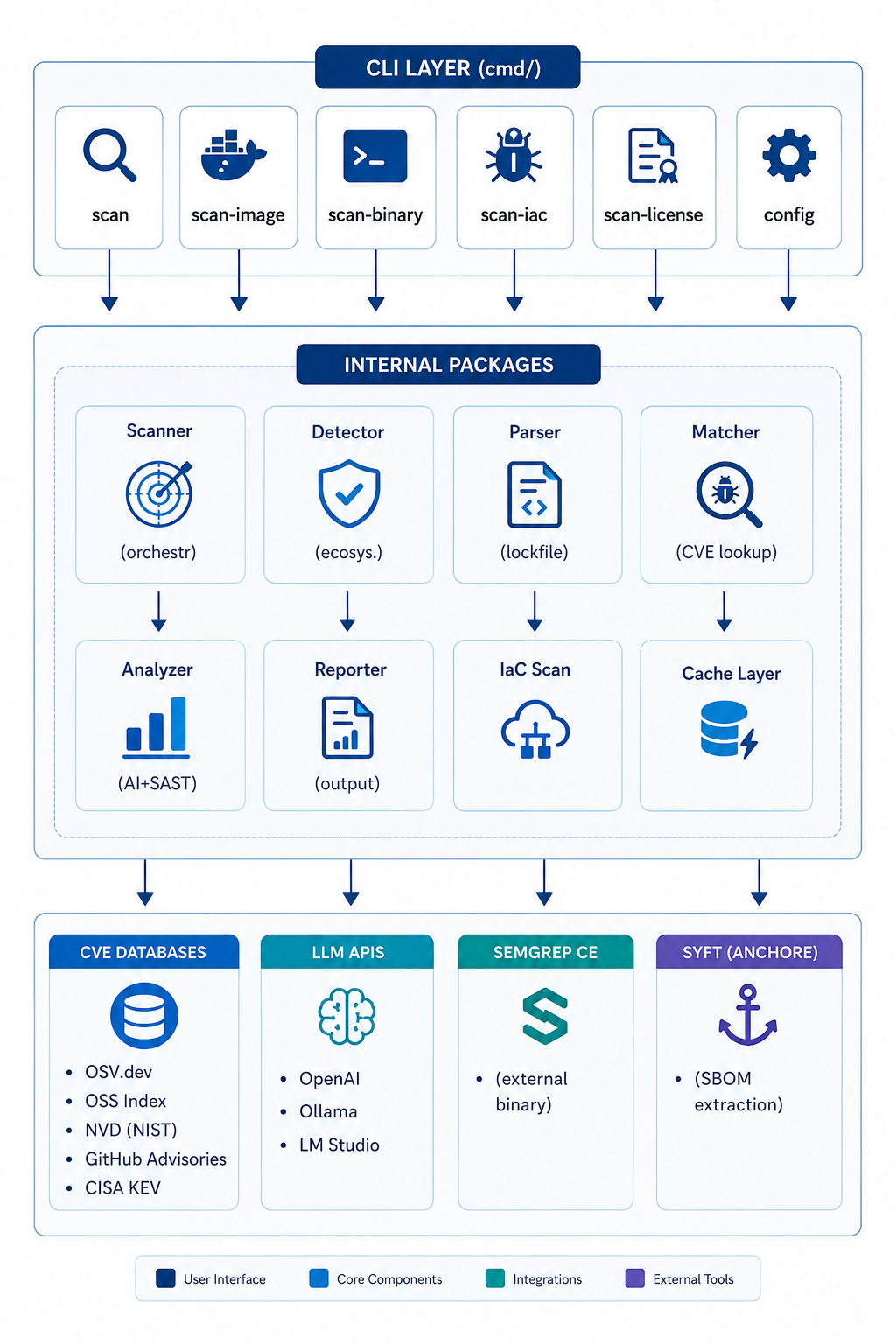
Component Responsibilities
| Component | Package | Purpose |
|---|---|---|
| CLI Layer | cmd/ | Command parsing, flag handling, user interaction |
| Scanner | internal/scanner/ | Pipeline orchestration — ties all engines together |
| Detector | internal/detector/ | Filesystem walk to identify project ecosystems |
| Parser | internal/parser/ | Extract dependencies from manifest/lock files; integrity checks |
| Matcher | internal/matcher/ | Query CVE databases; canonical normalize + merge; KEV enrichment |
| Analyzer | internal/analyzer/ | AI code analysis, 52 pattern rules, 101 Semgrep rules across 4 bundled packs |
| Reporter | internal/reporter/ | Format and emit scan results (8 formats) |
| Image Scanner | internal/image/ | Container image scanning via Syft |
| IaC Scanner | internal/iac/ | Regex-based misconfiguration scanner (25 rules) |
| Binary Scanner | internal/binary/ | SCA on compiled artifacts (Go, JAR, Python wheel) |
| License | internal/license/ | License classification, SPDX parser, registry resolver |
| Cache | internal/cache/ | File-based vulnerability response caching |
| Config | internal/config/ | Credential & preference management; OS keyring + fallback |
| FS Util | internal/fsutil/ | Shared skip-dir rules for all walkers |
| Models | internal/models/ | Shared data structures (Vulnerability, Package, etc.) |
Scan Pipeline Flow
1. DETECT      → Find manifest files, identify ecosystems
2. PARSE       → Extract packages from lock files, generate PURLs
3. MATCH       → Query all databases concurrently
4. NORMALIZE   → Apply Canonical Data Model (ID preference, severity fallback)
5. MERGE       → Combine duplicate findings across sources
6. ENRICH      → CISA KEV lookup, mark exploited-in-the-wild
7. ANALYZE     → Pattern rules + Semgrep + AI (if enabled)
8. REPORT      → Format output (table/json/sarif/html/pdf/...)
Matcher Architecture
The matcher package uses an interface-based design:
type Matcher interface {
    Name() string
    Match(ctx context.Context, packages []models.Package) ([]models.Vulnerability, error)
}
Implementations:
OSVMatcher— batch API, 1000 packages/requestOSSIndexMatcher— PURL-based, 128 coords/batchNVDMatcher— paced package keyword search plus exact-CVE CVSS enrichmentGitHubAdvisoryMatcher— ecosystem-based advisory lookup
Aggregation:
AggregatedMatcherruns all matchers concurrently- Results are normalized via
Normalize()(canonical.go) - Duplicates are merged via
Merge()(fills missing fields) KEVEnricherflags exploited CVEs post-aggregation
Extensibility
| Extension Point | Interface / Pattern | How to Add |
|---|---|---|
| New CVE source | matcher.Matcher | Implement Name() + Match(), add to scanner’s matcher list |
| New parser | parser.Parser | Implement Parse(), register in ecosystem detection |
| New output format | reporter.Reporter | Add format handler in reporter package |
| New IaC rule | Rule struct in iac/ | Add regex pattern + metadata |
| New AI provider | Same interface as OpenAI/Ollama | Implement chat completion handler |
Security Design
| Layer | Protection |
|---|---|
| Secrets | OS keyring (macOS Keychain, Windows CM, Linux SS); file fallback with 0600 permissions |
| Output | All report files written with 0600 permissions |
| Input | Image references validated against shell metacharacters |
| Dependencies | Integrity verification via lockfile checksums |
| Network | TLS enforced; rate limiting respected; graceful degradation on API failures |
| Cache | Local file-based; keyed by SHA-256 of source + package list |